
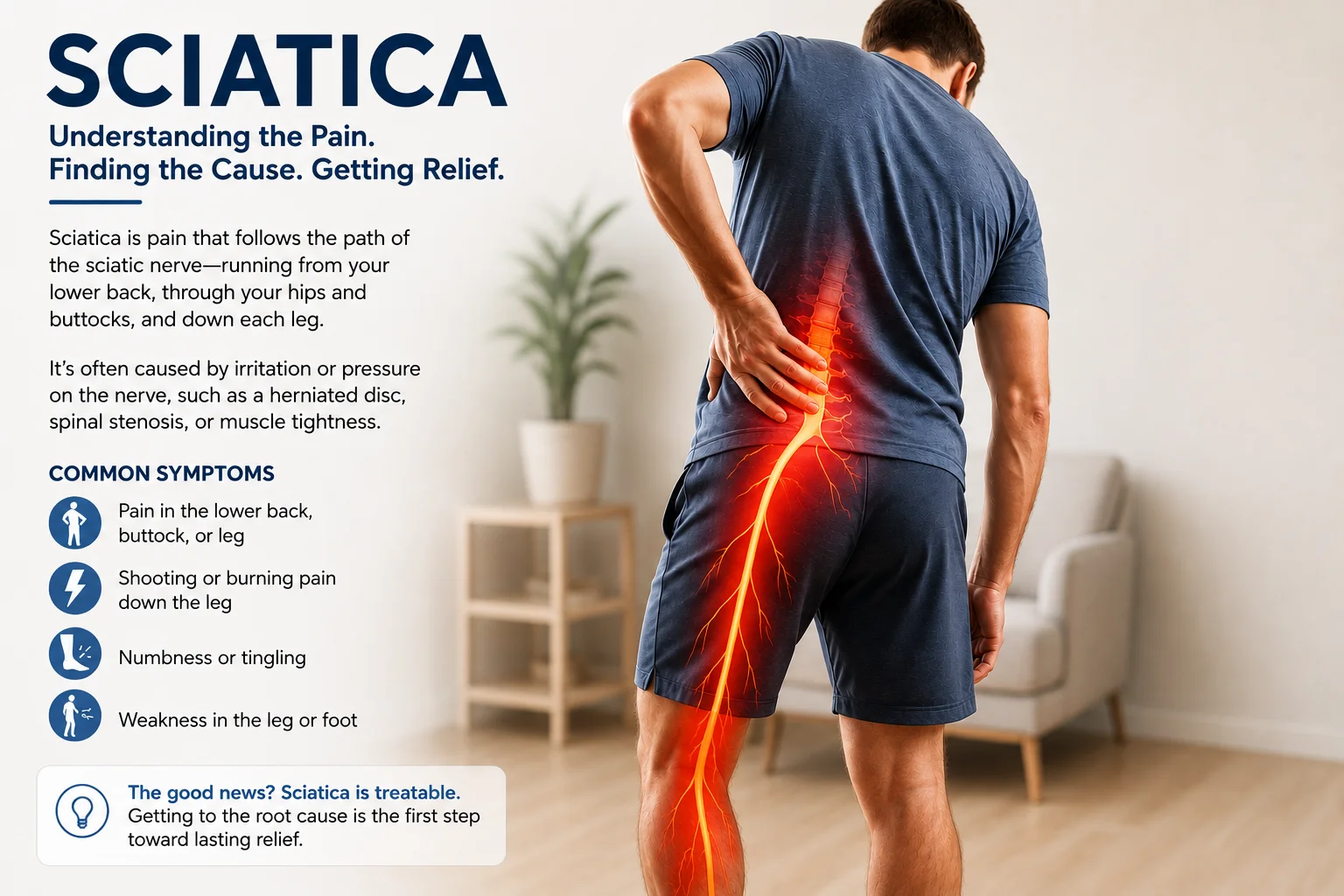
If you've ever felt a sharp, electric pain shoot from your lower back all the way down through your buttock and into your leg, you already know sciatica doesn't mess around. It's one of the most common complaints we hear about at New Leaf Chiropractic, and it's also one of the most misunderstood. A lot of people assume they just have to live with it. They don't.
What Exactly Is Sciatica?
Sciatica isn't actually a diagnosis on its own. It's a symptom, specifically pain that travels along the path of the sciatic nerve. That nerve is the longest in your body, running from your lower spine through your hips and buttocks and down each leg. When something irritates or compresses it, you feel it.
The most common culprits are a herniated or bulging disc in the lumbar spine, bone spurs, or spinal stenosis (a narrowing of the spinal canal). Sometimes tight muscles, like the piriformis in the hip, can also press on the nerve and cause similar symptoms.
How Do You Know If It's Sciatica?
The hallmark sign is pain that starts in the lower back or deep in the buttock and radiates down one leg, sometimes all the way to the foot. It usually affects only one side at a time. Beyond the pain itself, people often describe:
- A burning or tingling sensation in the leg or foot
- Numbness or weakness in the affected leg
- Pain that gets worse when sitting for long periods
- Sharp jolts when coughing, sneezing, or standing up
- Difficulty moving the foot or toes on the affected side
If any of that sounds familiar, and you're in the Hurst, Euless, Bedford, or North Richland Hills area, it's worth getting a proper evaluation. Sciatic nerve pain can sometimes signal an issue that needs prompt attention, so don't just guess.
How the Prone Specific Technique Helps
At New Leaf Chiropractic, Dr. Begin uses a technique called Prone Specific, a gentle, precise approach to chiropractic adjustments that's particularly well suited for people dealing with lower back and nerve-related pain like sciatica.
Here's why it matters: traditional high-velocity adjustments work well for many people, but for someone whose sciatic nerve is already irritated, a lighter, more targeted approach can make a real difference in comfort and outcomes. Prone Specific focuses on identifying exactly which vertebrae are out of alignment and correcting them with controlled, specific force, applied while you lie face down, relaxed.
Reducing Pressure on the Nerve
When a vertebra shifts out of its normal position, it can narrow the space through which nerve roots exit the spine. By restoring proper alignment, chiropractic adjustments can reduce that pressure and give the irritated nerve room to calm down. Many patients notice a difference in their leg pain within the first few visits, though everyone's situation is different and results vary.
Addressing the Root Cause
Medication can quiet the pain signals, but it doesn't change whatever is pressing on the nerve. Chiropractic care aims to correct the underlying structural problem rather than just mask the symptom. That's a meaningful distinction if you want lasting relief rather than a temporary fix. You can learn more about the full range of services we offer at drcurtisbegin.com/services.
When to Seek Help
If your pain is severe, has lasted more than a few weeks, or you're experiencing any loss of bladder or bowel control (which can be a sign of a more serious condition called cauda equina syndrome), please seek care promptly. For most people, though, sciatica responds well to conservative care, and chiropractic is a solid first step before considering more invasive options.
Ready to find out what's actually going on with your back and leg pain? Reach out to schedule an appointment and we'll take a careful look together.