
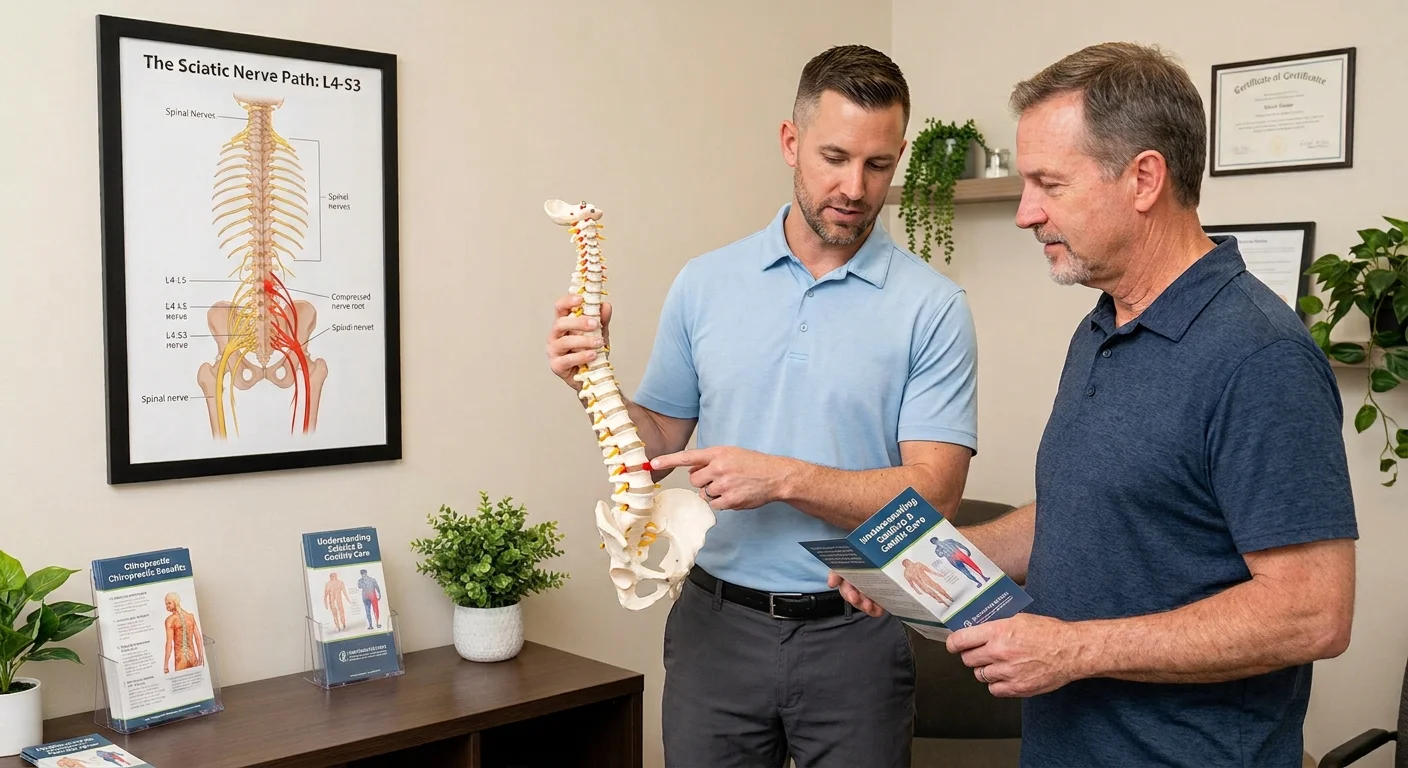
Sciatica has a way of taking over your whole day. One minute you are fine, and the next you are gripping the back of a chair because a sharp jolt just ran from your lower back all the way down your leg. If that sounds familiar, you are not alone, and you are probably wondering whether seeing a chiropractor for sciatica is worth your time.
The short answer is that it often is, especially when the approach is gentle and tailored to your specific situation. But let's back up and look at what sciatica actually is, what tends to cause it, and what a gentle chiropractic evaluation can realistically offer.
What Is Sciatica, Really?
Sciatica is not a diagnosis on its own so much as a description of a set of symptoms. The sciatic nerve is the longest nerve in your body, running from your lower spine through your hips and buttocks and down each leg. When that nerve gets compressed or irritated, it can produce:
- Sharp or burning pain that travels down one leg (occasionally both)
- Numbness or tingling in the leg, foot, or toes
- Muscle weakness in the affected leg
- Pain that worsens with prolonged sitting
- A feeling like an electric shock when you move a certain way
The intensity can range from mildly annoying to genuinely debilitating. For more detail on what contributes to this kind of pain, the sciatica page on this site walks through the mechanics in plain language.
Common Causes Behind Sciatic Pain
Understanding the cause matters a lot because different causes respond differently to care. The most frequent culprits include:
Herniated or Bulging Disc
When the soft material inside a spinal disc pushes outward, it can press on nearby nerve roots, including those that feed into the sciatic nerve. This is one of the most common reasons people end up with classic sciatica symptoms.
Lumbar Subluxation
Chiropractors use this term to describe a spinal joint that is not moving properly or is slightly out of its ideal position. Even small misalignments in the lower back can create enough irritation to set off the sciatic nerve.
Piriformis Syndrome
The piriformis is a small muscle deep in your buttock. In some people, the sciatic nerve passes through or right next to it, and if that muscle tightens up or spasms, it can mimic sciatica almost exactly.
Degenerative Disc Changes or Stenosis
As spinal discs age or the spinal canal narrows, nerve roots can be encroached upon. This tends to show up more gradually than disc herniations and is common in older adults.
Figuring out which of these is driving your pain is exactly why a proper evaluation matters before any care begins. You can also learn more about how lower back problems overlap with sciatic pain on the back pain page.
How a Gentle Chiropractor for Sciatica May Help
The word "gentle" is doing real work here. Traditional high-velocity adjustments are not the only way to address spinal alignment. At New Leaf Chiropractic, Dr. Begin uses the Prone Specific technique, which involves low-force, precise adjustments that do not require twisting or cracking. For someone already dealing with nerve pain, that matters a great deal.
Here is what gentle chiropractic care may offer for sciatica:
Reducing Nerve Pressure at the Source
By restoring better alignment and motion to the lumbar spine and sacrum, a chiropractor may help take some of the mechanical pressure off the affected nerve root. Less compression often means less pain over time.
Improving Spinal Mobility
Stiff, restricted spinal joints contribute to poor movement patterns that can keep aggravating the nerve. Gentle adjustments aim to restore normal range of motion without adding trauma to already irritated tissue.
Supporting the Body's Own Healing Process
Chiropractic care is not about forcing the body to do something. The goal is to remove interference so your nervous system and surrounding structures can function the way they are meant to. That is a more modest claim than a cure, but it is an honest one.
If you are curious how this fits into a broader approach to lower back care, this post on gentle chiropractic for lower back pain gives more context.
When to Seek Care Promptly (and When to Go to the ER)
Most sciatica improves with conservative care over weeks to months. But there are situations where you should not wait for a chiropractic appointment and instead go straight to an emergency room or urgent care:
- Sudden loss of bladder or bowel control alongside back pain
- Severe or rapidly worsening weakness in both legs
- Sciatica following a significant trauma like a fall or accident
- Numbness in the inner thighs or groin area (saddle anesthesia)
These can be signs of cauda equina syndrome, which is a medical emergency. Please do not delay care if any of those apply to you.
For most people, though, sciatica that has been building gradually and causes pain, tingling, or mild weakness is a good candidate for a chiropractic evaluation to see whether conservative care is appropriate.
Why Patients in Hurst, Euless, Bedford, and North Richland Hills Choose a Gentle Approach
People driving in from across the mid-cities area often come to see Dr. Begin specifically because they have heard about the gentle Prone Specific technique. Many of them tried more forceful approaches elsewhere and found them too uncomfortable or were nervous about traditional manipulation given their nerve pain.
Gentle does not mean ineffective. It means the force is controlled, the contact is precise, and the patient is not bracing themselves on the table dreading what comes next. That alone changes the experience, and for people whose sciatic symptoms have made them guarded and anxious about movement, starting from a calmer place tends to produce better results.
Dr. Begin takes time at the first visit to understand your history, your symptoms, and whether chiropractic is the right fit. If it is not, he will say so and help you find the right direction. That kind of honest evaluation is what keeps patients coming back from Euless, Bedford, North Richland Hills, and throughout the Hurst area.
Frequently Asked Questions
How many visits does it take to see results?
It really depends on how long the problem has been there, the underlying cause, and how your body responds. Some people notice meaningful improvement in a handful of visits. Others with more chronic or complex presentations take longer. Dr. Begin will give you a realistic picture after your initial evaluation.
Will the adjustment hurt if I already have nerve pain?
With a gentle technique like Prone Specific, most patients are surprised by how comfortable the adjustments feel. There can be some mild soreness afterward, similar to how muscles feel after a workout, but the dramatic discomfort people sometimes expect does not typically happen with low-force methods.
Can I keep doing other treatments alongside chiropractic?
In most cases, yes. Stretching, walking, physical therapy, and certain medications can all work alongside chiropractic care. Dr. Begin will ask what else you are doing and make sure your overall plan makes sense.
What if chiropractic does not help my sciatica?
Not every case of sciatica is a chiropractic case. If your symptoms are not responding or point to something that needs a different kind of intervention, Dr. Begin will be straightforward about that and can help coordinate with other providers as needed.
Ready to find out whether chiropractic is a good fit for what you are dealing with? Visit the services page for an overview of what Dr. Begin offers, or go ahead and reach out with questions before booking.