
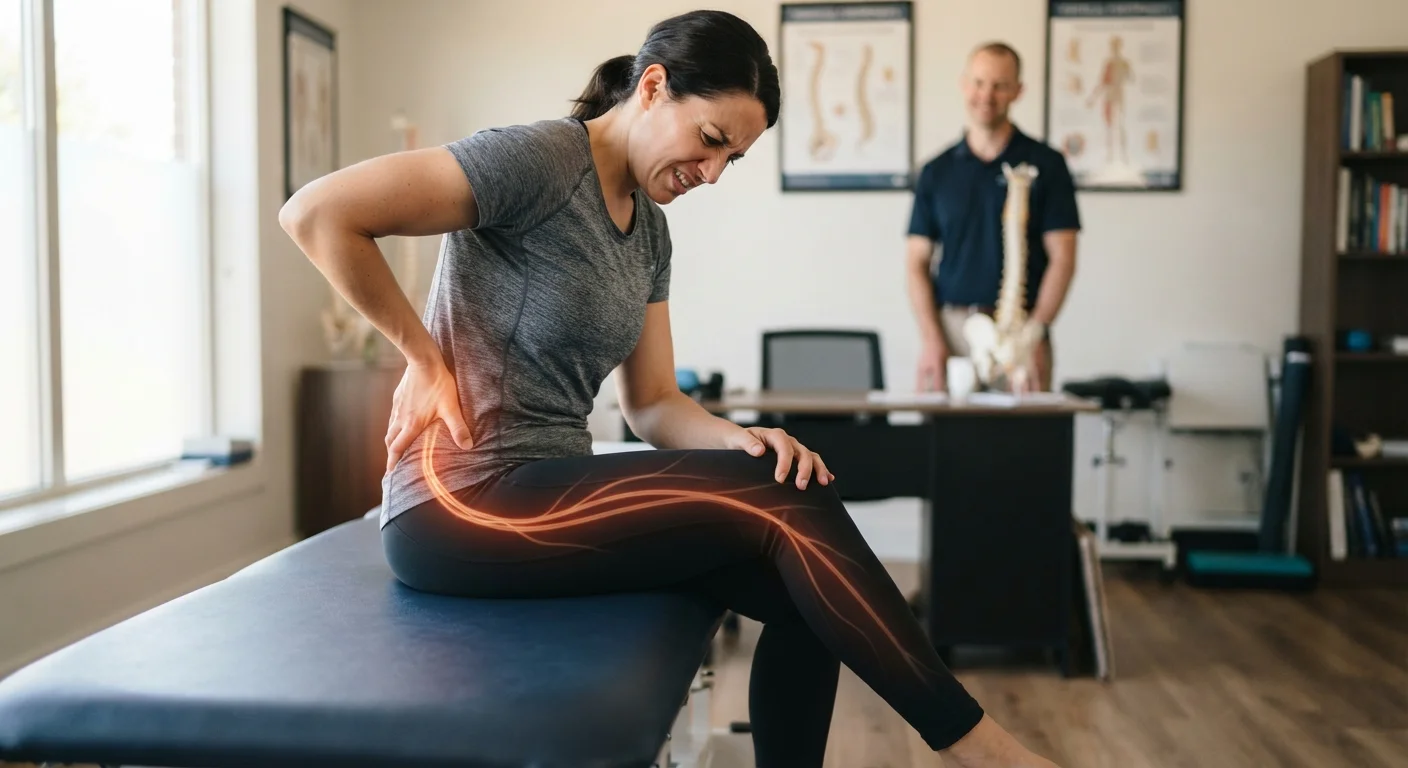
That nagging ache in your lower back is one thing. But when the pain starts traveling, when it runs down through your hip, your thigh, maybe all the way to your foot, it can feel alarming. You might have heard the word "sciatica" thrown around, but what does it actually mean? And more importantly, what can you do about it?
Let's walk through what's actually happening, what the common causes are, and how a gentle chiropractic evaluation might help you figure out your next step.
What Is Sciatica, Exactly?
Sciatica isn't a diagnosis on its own, it's more of a description. It refers to pain that follows the path of the sciatic nerve, which is the longest nerve in the body. That nerve runs from your lower back, through your buttocks, and down each leg. When something irritates or compresses it, you can feel pain, tingling, numbness, or weakness anywhere along that entire path.
So when people say they have sciatica, they're usually describing back pain radiating down the leg, often on just one side. The sensation can range from a dull throb to a sharp, electric jolt, and it tends to get worse when sitting for long periods or standing up suddenly.
Common Causes of Pain Down the Leg from the Back
Several different underlying issues can produce that familiar lower back pain into the leg pattern. The most common ones include:
Herniated or Bulging Disc
The discs between your vertebrae act as cushions. If one bulges out of place or ruptures, it can press directly on a nearby nerve root, including the sciatic nerve. This is probably the most well-known cause of sciatica symptoms.
Spinal Misalignment
When vertebrae in the lumbar spine shift out of their normal position, the resulting pressure or altered movement patterns can irritate surrounding nerves. This is a key area where chiropractic care focuses.
Piriformis Syndrome
The piriformis is a small muscle in the buttocks. In some people, the sciatic nerve runs directly through or under it. If that muscle tightens or spasms, it can squeeze the nerve and produce symptoms that feel a lot like classic sciatica.
Spinal Stenosis
This refers to a narrowing of the spinal canal, which reduces the space available for your nerves. It's more common in older adults and can cause significant lower back pain and leg symptoms, especially with prolonged walking.
How Gentle Chiropractic Care May Help
Not all chiropractic care looks the same. At New Leaf Chiropractic, Dr. Begin uses the Prone Specific technique, which is a low-force, precise approach. There's no twisting, no cracking, and no sudden movements. For patients dealing with sciatica symptoms, that gentleness matters a lot.
The idea is to identify and correct vertebral misalignments that may be contributing to nerve irritation. When the spine is better aligned and moving more freely, the nervous system has a better environment to function in. Some patients notice meaningful improvement in their leg pain; others find that their back feels looser and more mobile even before the leg symptoms fully resolve. Results vary from person to person, and chiropractic care isn't a cure-all, but for many people it's a genuinely helpful piece of the puzzle.
You can read more about the specific approach Dr. Begin takes on the gentle chiropractic for sciatica page.
It's also worth understanding that not all leg pain originates from the sciatic nerve. Dr. Begin's evaluation process helps sort out what's actually driving your symptoms. If you're unsure whether you're dealing with true sciatica or a different type of back-related leg pain, this resource on sciatica vs. back pain is a good starting point.
When You Should Seek Evaluation Right Away
Most cases of back pain radiating down the leg are uncomfortable but not emergencies. That said, there are some symptoms that mean you should skip the chiropractic office and go straight to an emergency room or urgent care:
- Loss of bladder or bowel control
- Numbness in the groin or inner thigh (saddle area)
- Sudden, severe weakness in both legs
- Pain following a significant fall or trauma
These can be signs of a serious condition called cauda equina syndrome, which requires immediate medical attention. If you're experiencing any of these, please don't wait.
For everything else, a professional evaluation is still the right move. The sooner you understand what's actually causing your symptoms, the sooner you can start moving in the right direction.
Why Patients in Hurst, Euless, Bedford, and North Richland Hills Choose a Gentle Approach
Folks across the mid-cities area, including Hurst, Euless, Bedford, and North Richland Hills, often arrive at New Leaf Chiropractic after trying other things first. Some have been hesitant about chiropractic because they've heard stories about aggressive adjustments. Others are dealing with pain severe enough that they're worried anything will make it worse.
The Prone Specific technique is designed with those concerns in mind. It's precise, it's low-force, and it's built around the individual patient's spine, not a one-size-fits-all protocol. Many patients are surprised by how comfortable the experience is, especially when they were bracing for something intense.
If you're local and looking for a conservative, non-invasive starting point for your leg and back pain, our full range of services is worth a look. And if you're ready to talk through your specific situation, we'd love to hear from you at our contact page.
Frequently Asked Questions
How do I know if my leg pain is actually sciatica?
True sciatica follows a specific nerve path, usually from the lower back through the buttock and down the back of one leg. If your pain travels in that pattern and is accompanied by tingling or numbness, it may well be sciatic nerve involvement. An in-person evaluation is the most reliable way to find out.
Can sciatica go away on its own?
Sometimes, yes. Mild cases can resolve with rest and gentle movement. But if your symptoms have lasted more than a few weeks, are getting worse, or significantly limit your daily life, it's worth getting checked out rather than waiting it out.
Is chiropractic care safe for sciatica?
For most people with typical sciatica symptoms, gentle chiropractic care is considered safe. Dr. Begin takes a thorough history and does a careful evaluation before recommending any care. If your case is better suited for a different type of provider, he'll tell you that too.
How many visits does it take to feel better?
That depends on what's causing your symptoms and how long you've had them. Some patients notice improvement quickly; others need more time. Dr. Begin will give you an honest sense of what to expect after your initial evaluation.
Do I need an X-ray or MRI before seeing a chiropractor?
X-rays are taken when medically necessary as part of the evaluation process. If an MRI is also needed to get a clearer picture of what's going on, Dr. Begin will let you know and help coordinate that referral.